
Resources DataFocus OT product brief
DataFocus OT · The enterprise ontology platform
Let AI into your business. Keep control.
Leadership wants AI in production. Employees are already pasting company data into outside AI tools. IT and legal won't hand the data over.
DataFocus OT uses a business ontology to give AI three things: a map of your business it can understand, a governed way in, and actions that a person approves. With those in place, you can say yes to AI with confidence.
What AI lacks in the enterprise is not intelligence
Today's models are capable. Inside a company, they usually lack three things.
Context
The model does not know your business. It cannot tell whether "Customer A" in the CRM, the ERP and a contract is the same company, whether "delivered" means finished, shipped or signed for, or which version of a rule is in force. Hand it a database and it has to guess table names and joins.
Boundaries
Connect AI straight to your data and nothing controls what it sees or changes. Configuring permissions separately for every AI does not scale, and the copies soon disagree.
The ability to act
An AI that only answers questions has limited value. Companies need problems followed through, with every step inside the rules and a person in control.
A business ontology supplies all three.
What a business ontology is
An ontology models one business area. Taking the product's built-in purchase-approval ontology as the example, it has five parts.
| Part | In DataFocus OT | In the purchase-approval ontology |
|---|---|---|
| Objects and relationships | Tables from different systems are organized under the ontology, with how they relate and what each relationship means, shown in the ontology graph | Nine tables covering purchase requests, approval events, process variants, bottlenecks, compliance findings, improvement tasks and audit records; for example, "audit records trace each purchase request by case number" |
| Rules and knowledge | The document center holds policies, rules and metric definitions, linked to the data they govern | Compliance rules, SLA and bottleneck rules, event-log definitions, and the procedure for writing back and auditing tasks |
| Indicators | Indicators, pushed to the right people on a schedule | — |
| Actions | Executions (scripts that calculate, check and write back) and business actions on control panels | A compliance-check script; panel actions to re-run mining, create a corrective task, request evidence, close a deviation or reopen it |
| Permissions | Your existing users, roles and resource permissions; agents are granted access one ontology at a time | Only authorized people and agents can see this ontology |
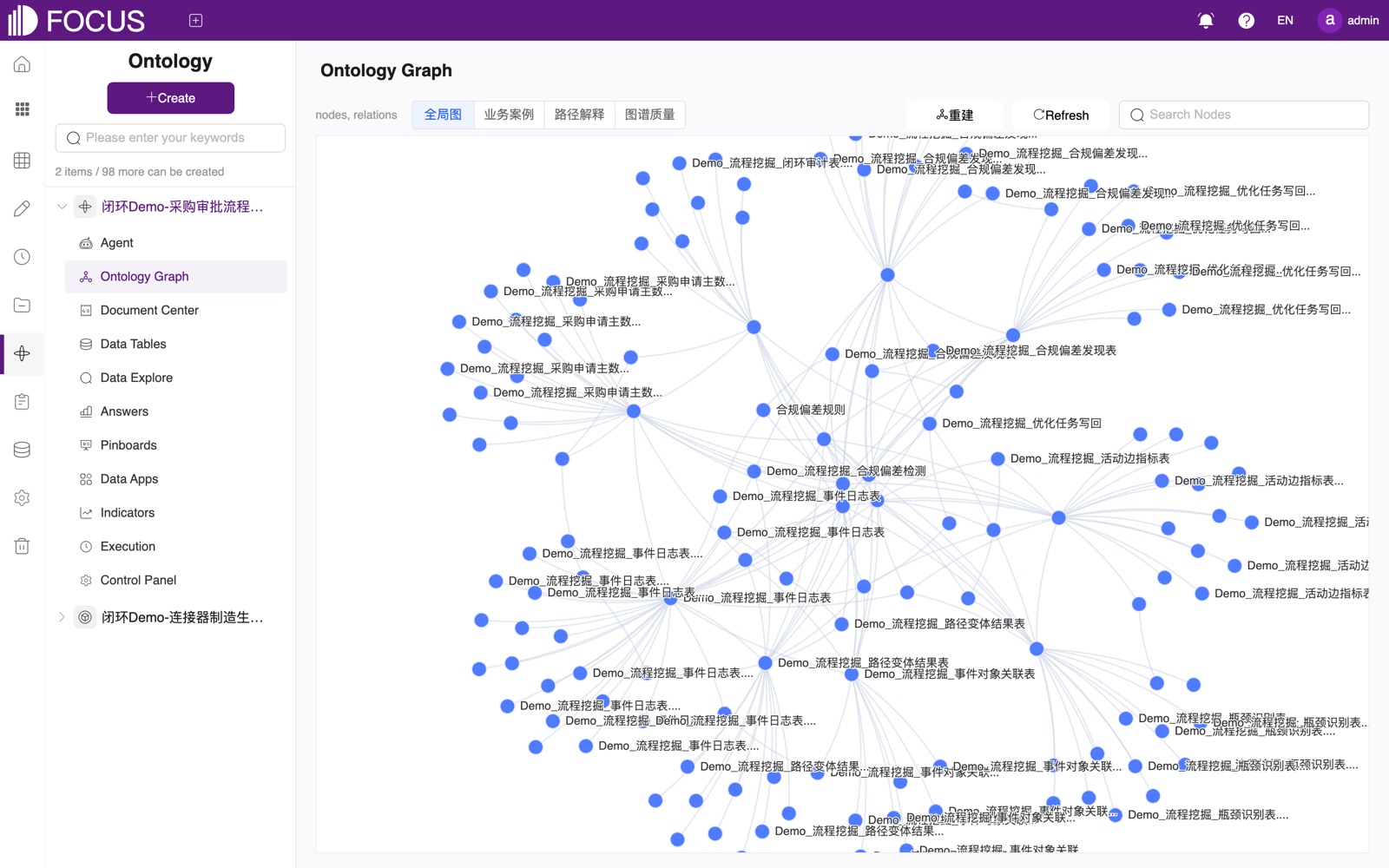
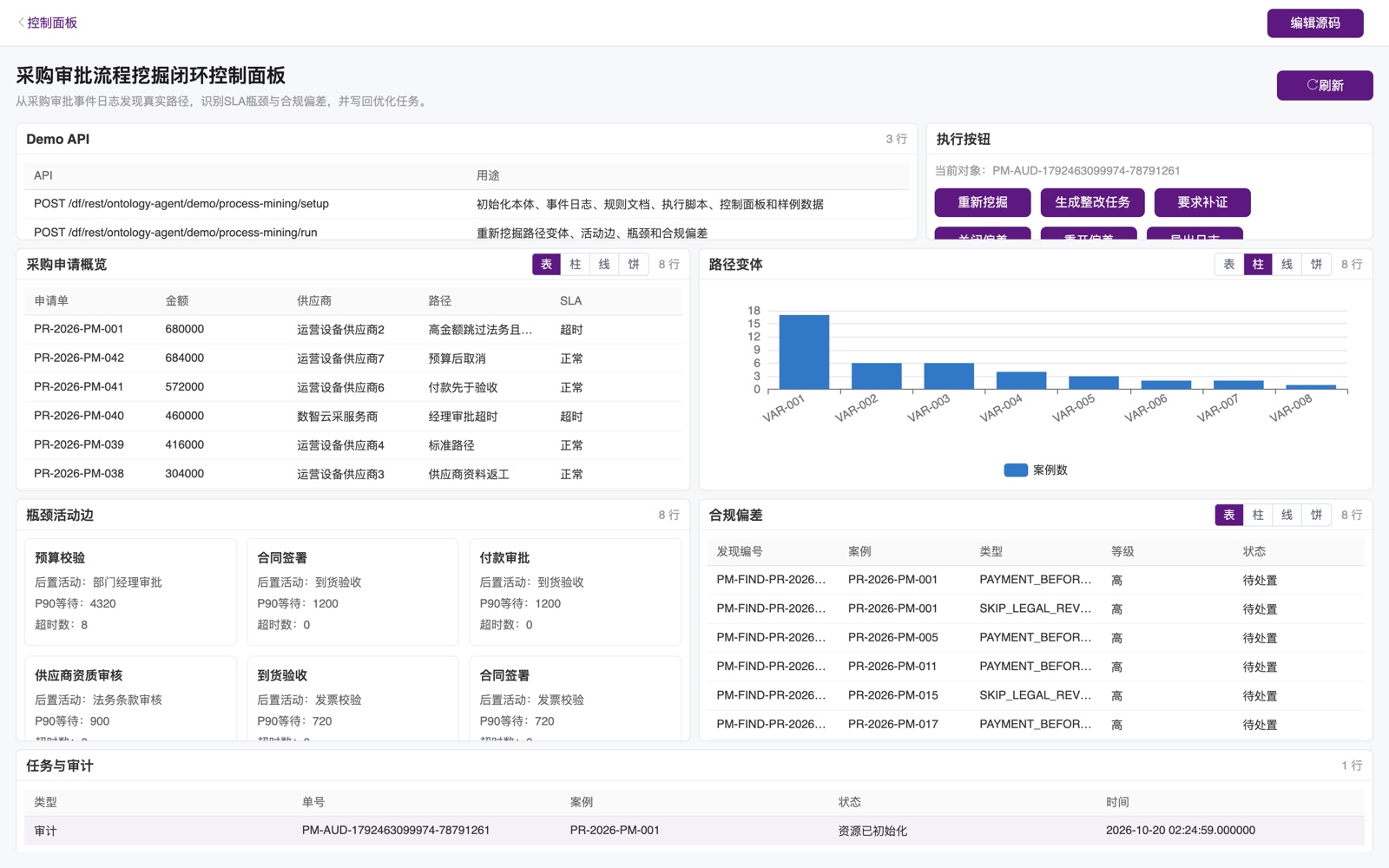
Every ontology has an ontology agent. Ask it a question in plain language and it answers from the ontology's data and documents, with evidence, and it can run the ontology's executions to analyze or write back.
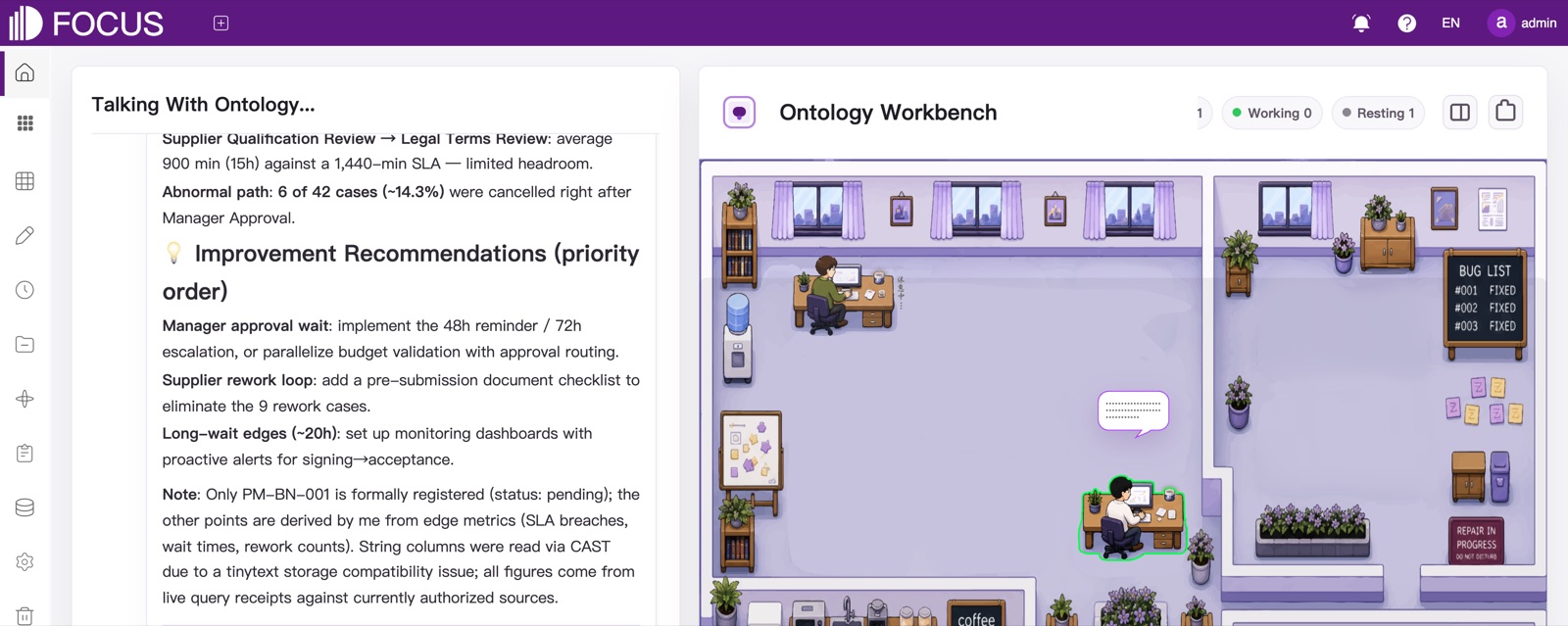
AI helps build the ontology. You do not have to build it by hand from scratch:
- in the product, AI can generate execution scripts and generate or revise control panels as drafts, which you validate and preview before saving;
- an external agent can draft an ontology from your data and documents and raise the business questions that need confirming, and the business owner confirms before it is publishedReported Stated by the product owner. Not tested by this site..
Evidence you can see
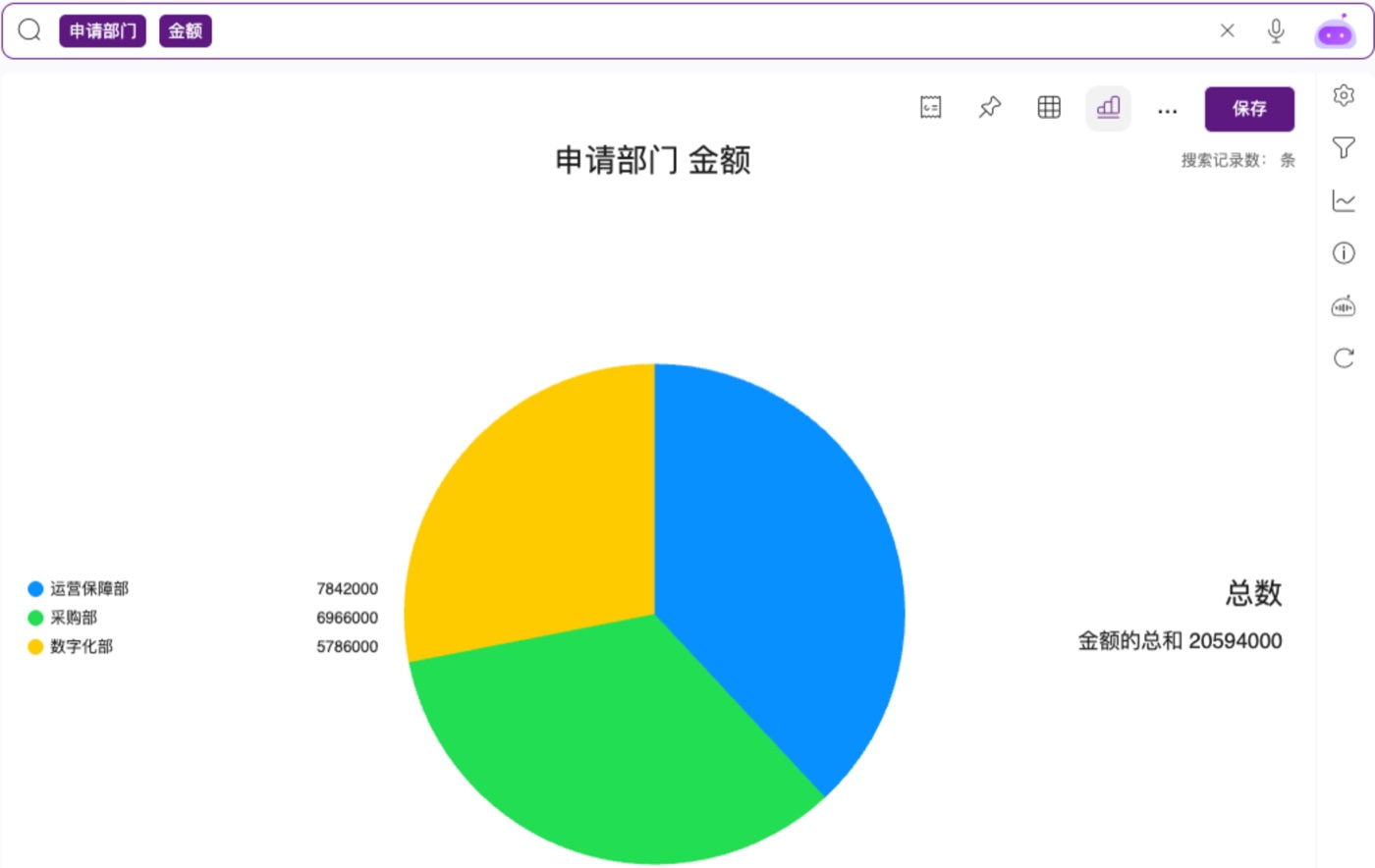
One question, and a business user and an AI agent get the same figures (using the product's built-in sample data).
Business user · Data Search for "requesting department, amount" (sample data in Chinese)
AI agent · Claude Code asks the same question through MCP
The department with the highest total is Operations Support, at 7,842,000 yuan.
- Operations Support7,842,000
- Procurement6,966,000
- Digital5,786,000
Basis: queried the purchase-request master table with SELECT "申请部门", "币种", SUM("金额") … GROUP BY "申请部门", "币种"; data fingerprint in the receipt evidenceRowsSha256 = 98e5b99a…d159. (Excerpt, translated from Chinese.)
The figures match line for line
What the ontology gives you
Define once, use everywhere
A business definition is set once and used by search analysis, dashboards, control panels, the ontology agent and external agents, which all get the same figures.
AI answers you can check
AI follows the objects and relationships defined in the ontology instead of guessing, and every query returns the SQL that ran, the tables it used and a data fingerprint.
AI stays within bounds
Permissions travel with the ontology: an agent gets only what the authorizing user may see, requests outside its grant do not reveal whether the data exists, and withdrawing access takes effect at once.
From finding a problem to fixing it
On a control panel, a business user selects an exception and creates a corrective task, requests evidence or closes the deviation. When AI wants to change something, it can only submit a draft, which takes effect after a person approves it.
Value beyond features
Say yes to AI
Many companies are stuck in the middle: leadership wants AI, IT and legal won't open up the data, and employees are already pasting data into outside AI tools. DataFocus OT turns "not allowed" into "allowed, under control": access is granted by permission, can be withdrawn, and changes need approval. AI gets used, and data stops leaking out the back door.
Stay in control as AI changes
Models change quickly. Your business knowledge lives in an ontology on your own servers, and you decide which models and agents connect to it. Switch, and you do not start over; your business knowledge is never handed to a single AI vendor.
Value that compounds
The first ontology is an investment. The next use case reuses the objects, rules and permissions already there, so each new AI application costs less. One-off AI pilots are usually thrown away; the ontology stays.
Accountability when something goes wrong
Every query has a receipt, every change has an approval record, and every agent action is also recorded in an audit logReported Stated by the product owner. Not tested by this site.. Which data was used, which rule applied and who approved it can all be traced. AI that can be held to account is AI that management can sign off.
Knowledge that stays with the company
The rules and practices in experienced employees' heads become an ontology. People move on; the knowledge stays, and new colleagues and new AI applications start from it.
Why DataFocus
Many products say they have an ontology. Most approaches fall into four groups.
| Approach | Good at | Falls short |
|---|---|---|
| Knowledge graph: entities and relationships extracted from documents | Search and Q&A | Amounts and totals come from the model and are unreliable; no business actions |
| Metrics or semantic layer built into a data platform | Accurate report figures | No rule documents or business actions; tied to that platform |
| Data catalog | Describing where data is and what it means | Describes data; plays no part in running the business |
| Heavyweight ontology platform | Completeness | Expensive and heavy to implement, relying on on-site teams; AI is often tied to the vendor's own products |
What DataFocus OT does differently
Numbers you can trust. A real compute engine sits underneath (Apache Doris in Flash; Trino and others in Heavy). Answers come from the SQL that actually ran, with a receipt you can check, instead of figures estimated by a language model. This builds on DataFocus's search-based analytics product.
Data, rules and actions in one ontology. The data says what happened, the rules say what should happen, and the actions let you deal with it.
Open to AI, governed by default. Any MCP-capable agent connects through standard MCP and OAuth. Permission inheritance, immediate revocation, change approval and query receipts are built in, not bolted on.
Light. Self-hosted, and Flash runs on a single engine. Start with one ontology without a large on-site team, and let AI help build it.
Shared by people and AI. The search analysis, dashboards and scheduled reports business users already have run on the same ontology. You invest once, and both sides benefit.
Capabilities
Business users
- Search-based analysis: type column names and keywords to get a chart, see the SQL that ran, and use forecasting and attribution analysis.
- Natural-language questions: ask FocusGPT, which turns the question into a query (a fix for the English interface is in progress).
- Ontology workbench: talk to the ontology agent, which combines data and documents in its answers.
- Control panels: see the state of the business and take actions directly.
- Answers, dashboards, and scheduled delivery to WeCom, DingTalk or Feishu.
- Data entry: design forms to collect and manage data.
- 21 interface languages, including Simplified Chinese, Traditional Chinese, English, Japanese and Korean.
AI agents (through MCP)
- A standard MCP server (Streamable HTTP) with OAuth authorization; clients such as Claude Code connect directly.
- Read ontologies, resources and the graph; run read-only queries within an ontology, with the SQL and a data fingerprint returned with every result.
- Submit drafts for control panels and other changes, applied after human approval.
- Natural-language analysis by DataFocus, and delegating tasks to the ontology agentReported Stated by the product owner. Not tested by this site.
AI-driven modeling researchReported Stated by the product owner. Not tested by this site.
Choose a business table and set the prediction target and evaluation metric. AI then carries out the modeling research:
- it investigates the data first, then proposes a baseline and candidate approaches;
- it trains models on the platform and compares them;
- it scores the chosen model independently, on data that was set aside in advance and is used only once;
- it adopts the result only if the improvement is reliable, and reports plainly when there is none;
- you download the predictions and the model training package from the page.
The research runs within a budget and your data permissions. It can be paused and resumed, and it stops if access to the data is withdrawn.
Data and IT teams
- Data access: import tables, connect external data sources, and build datasets and formulas.
- Data governance: asset catalog, asset panorama and data service APIs.
- Administration: organization, roles and resource permissions, AD/LDAP sync, and the operations external agents may perform, with change approval.
Two editions
| Item | OT Flash | OT Heavy |
|---|---|---|
| Compute and storage | Apache Doris as both in-memory engine and data warehouse | Hadoop, Hive, Trino and Iceberg |
| Business ontology | Yes | Yes |
| AI agent access (MCP) | Yes | YesReported Stated by the product owner. Not tested by this site. |
| Data pipelines | — | ETL (DataSpring, built on Flink) |
| AutoML and AI-driven modeling research | — | YesReported Stated by the product owner. Not tested by this site. |
| Best for | Teams that want an ontology for one business area running quickly, with data that can sit in a single analytical engine | Enterprises with large data volumes and an existing big-data platform that need pipelines and modelling |
First step: start with one ontology
- Pick a business question that has data, policy documents and a clear owner, such as order delivery or purchase approvals.
- Bring the relevant tables and rule documents, and build your first ontology.
- Get business users working on it, then authorize an AI agent to connect.
- Once it works, move on to the next business area.
- Self-hosted: DataFocus OT runs on your own servers. Administrators configure the large-language-model service; if you use an external model, confirm what is sent to it under your data policy.
- Documentation: user manuals in Chinese and English, with screenshots taken from the real product, plus an agent and MCP integration guide.
Reported Stated by the product owner. Not tested by this site. Stated by the product team; not yet tested by this site.